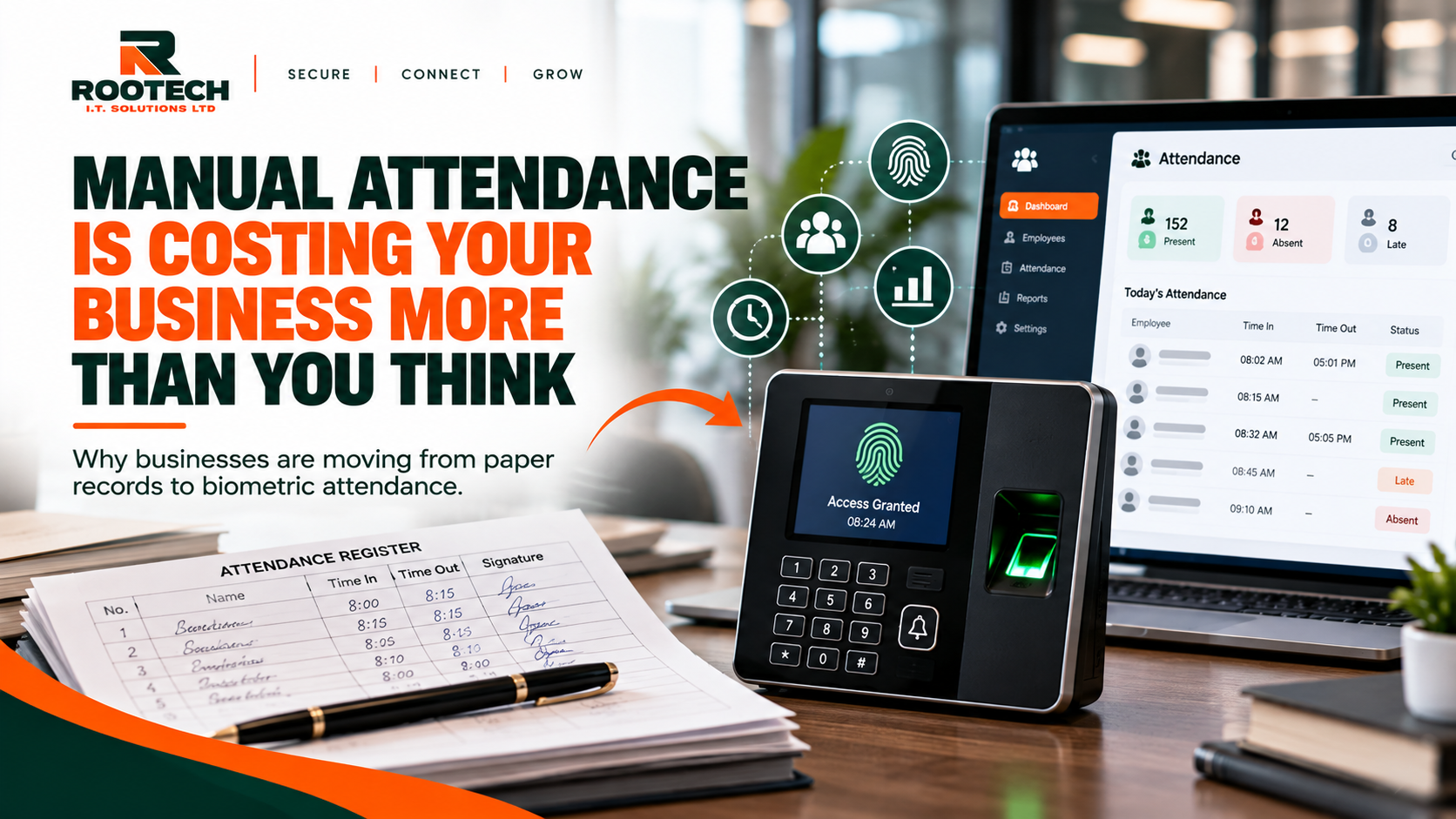
Employee attendance is more than just knowing who came to work.
For many businesses, attendance records affect payroll, punctuality, shift management, overtime, access control and overall accountability. Yet some businesses still rely on paper attendance books, spreadsheets or manual sign-in processes.
These methods may work when a business is small, but as the workforce grows, managing attendance manually can become time-consuming and difficult to monitor accurately. A biometric attendance system provides a more structured way to record employee attendance using technologies such as fingerprint and facial recognition.
The Problem With Manual Attendance
A paper attendance book may seem simple and inexpensive, but it can create several operational challenges. Employees may forget to sign in or out. Records can be difficult to verify. Managers may spend unnecessary time reviewing attendance sheets, while HR teams may have to manually transfer information into other systems.
For businesses with multiple departments, shifts or locations, these challenges can become even more difficult to manage. The issue isn't necessarily the attendance book itself. The bigger issue is that manual records provide limited visibility and require significant human effort to maintain.
1. It Takes Time to Manage
Someone has to collect attendance records, review them, organize them and prepare reports. As the number of employees increases, so does the amount of administrative work.
A biometric system can automate much of the attendance-recording process, allowing employee clock-in and clock-out information to be captured digitally. This can reduce repetitive administrative tasks and make attendance information easier to access.
2. Attendance Records Can Be Difficult to Verify
With manual records, managers may have difficulty determining whether attendance information is complete and accurate. Digital biometric systems can link attendance records to individual employees using biometric identification such as fingerprints or facial recognition.
This creates a more structured record of when employees access the system.
3. Managing Multiple Shifts Becomes More Complicated
Businesses operating different shifts need a reliable way to monitor attendance across different working periods. Manually tracking morning, afternoon, evening or rotating shifts can quickly become complicated.
A digital attendance system can make it easier to organize attendance information according to the business's operational structure.
4. Attendance and Access Control Can Work Together
Attendance management doesn't have to exist separately from workplace security. Businesses can integrate biometric technology with access-control systems to help manage who is permitted to enter specific areas.
For example, access can be restricted to authorized personnel while the system simultaneously records the access event. Rootech provides biometric solutions including fingerprint and facial recognition, time and attendance systems, turnstiles and access-control solutions. (Rootech IT Solutions)
5. Growing Businesses Need Better Records
As a business grows, administrative systems need to grow with it. What works for a small team of five or ten employees may become difficult to manage when the organization has dozens or hundreds of employees.
Moving from manual attendance to a digital system can provide a more organized foundation for managing employee records and workplace access.
What Can a Biometric System Help Your Business Manage?
Depending on the system deployed, businesses can use biometric technology for:
-
Employee attendance
-
Clock-in and clock-out records
-
Access control
-
Staff identification
-
Shift management
-
Restricted-area access
-
Attendance reporting
-
Workplace accountability
The right solution depends on the size of the organization, number of locations, workforce structure and security requirements.
Biometrics Is More Than Fingerprint Scanning
When people hear "biometrics," they often think only about fingerprint scanners. Modern biometric systems can also use facial recognition and other identification technologies, depending on the equipment and application.
For businesses, the goal isn't simply to install a biometric device. The goal is to implement a system that fits into the organization's broader attendance, access and security processes.
Make Attendance Management Smarter
Manual attendance may seem like a small administrative issue, but inefficient processes can accumulate as a business grows. A digital biometric system can help businesses create more structured attendance records, improve access control and reduce some of the manual work involved in managing employee attendance.
At Rootech IT Solutions, we provide biometric and access-control solutions designed around business requirements. (Rootech IT Solutions)
Your employees are an important part of your business. Your systems should help you manage them efficiently.
Ready to upgrade your attendance and access-control system?
+233 54 631 0011
info@rootechits.com
www.rootechits.com
Japan Motors, Room 6, Adenta, Accra
Rootech IT Solutions — Secure. Connect. Grow. (Rootech IT Solutions)
