
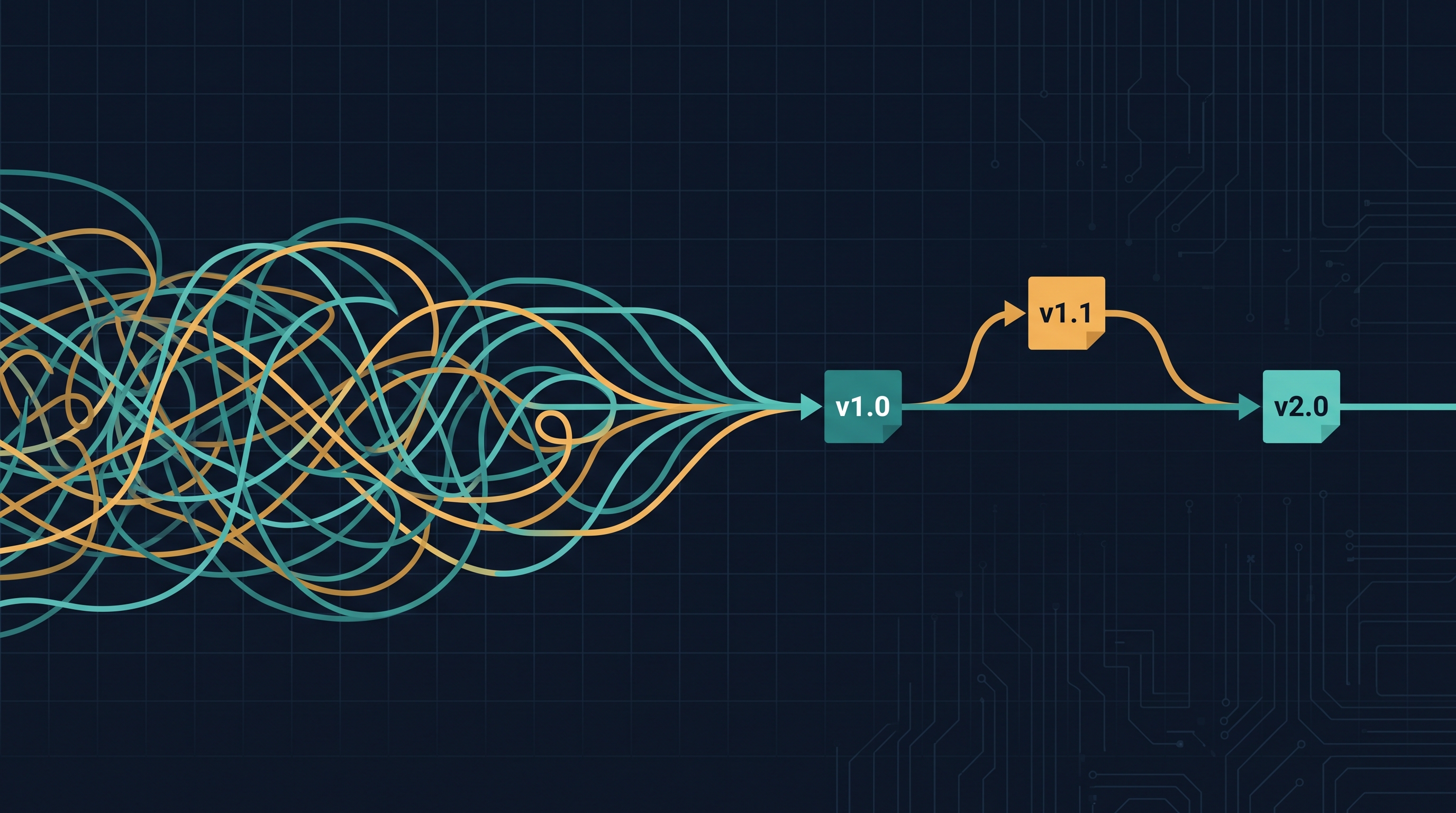
There's a lesson I learned early in my journey as a builder that took me years to fully articulate, and it changed the way I ship products. Most people think of versioning as something that only applies to code — you commit, you push, you tag a release. But versioning goes far beyond that. Even if you're a no-code builder, understanding versioning at the level of ideas is one of the most important skills you can develop. Here's how I got there, and why it matters.
Where It Started
My goal has always been to build and own something real — first a product, an app, a piece of software. Over time, that ambition grew into something bigger: running an organization, leading a team of innovators. But you can't be productive in either of those worlds without understanding a few foundational principles first.
In my early days, I got pulled into hacking — like a lot of people my age, the spark came from Hollywood. Watching those movies, I eventually realized something important: most of the "technology" on screen is speculative fiction, dressed up to look real. Only a small fraction of it actually exists. That realization didn't kill my interest — it redirected it. I wanted to understand what was actually possible, not just what looked cool on a screen.
As I went deeper into ethical hacking, I met real practitioners here in Ghana. Many of them showed me quick wins — flashy, instant plays that felt impressive in the moment but had a low ceiling. They worked, but only just barely, and only for a while.
The Conversation That Changed My Approach
In 2015, I was at the Vodafone café in the A&C Mall, working through an ethical hacking course, when a man sat down and struck up a conversation. He told me something I still carry with me: if I genuinely wanted to hack for good — for positive, constructive outcomes — I first had to understand how the system I was attacking actually worked. That understanding, he said, is 99% of the job.
Tools will get you access. Anyone can get access, especially given how careless most people are with their own security. But what you do after you're in depends entirely on how deeply you understand the system itself. He told me the only real way to build that understanding was through reverse engineering — and more than that, by learning to think the way the engineers who built the system originally thought. His advice was blunt: build similar tools yourself. Reverse-engineer anything you come across. And at the core of all of it, master programming.
What Programming Actually Is
This is the part that reshaped everything for me.
Most people, when they think about programming, picture code — lines of syntax, brackets, semicolons. That's a fundamental misunderstanding of what the craft actually is.
Programming is the art of instructing an object to follow a set of directions. It's algorithm design. It's thinking made structured. Coding — the act of writing lines that a machine can interpret — is just the mechanism through which that thinking gets executed. That's precisely why we call them programs, not codes. The word itself carries the distinction.
Chasing a real understanding of programming eventually led me into systems design and architecture. And that's exactly where the concept of program versioning enters the picture.
Program Versioning vs. Code Versioning
Versioning, at its core, is the practice of preserving a compiled, accepted, or working state of something. Most developers are comfortable with code versioning — tools like GitHub have made that second nature. You commit a change, you tag a release, you roll back if something breaks.
Program versioning is a different discipline entirely. It's not about the codebase — it's about the functionality the user actually experiences.
When an app you use pushes a new release, what changes under the hood is a new version of the code. But from the user's seat, what they see is a new version of the program — a new capability, a new interaction, a new reason to open the app again.
As a founder or a project lead, I'd argue you need to prioritize program versioning over code versioning — especially now, in an AI-driven era where a single idea can be shipped by a hundred different people on the same day. If you don't build a program versioning discipline, your work risks staying locked inside your internal team indefinitely. I know this because I lived it.
The Mistake I Kept Making
Early in my career, I built internal tools for organizations I worked with — SMHOS, SMDESK, WHISPER. These were genuinely useful systems. And yet, the organizations I built them for never got to actually use them, because I had no concept of program versioning.
The pattern was always the same. Every time I felt ready to make a tool public, a new idea would surface. I'd pause the release to chase that idea. And without fail, there was always another idea waiting right behind it. The goalpost kept moving because I never drew a line and called anything "done."
Building Venta Retail Suite Broke the Cycle
When I started building Venta Retail Suite — a project close to my heart — I ran into the exact same wall. Nothing shipped, because nothing ever felt finished. It wasn't until I started studying program versioning seriously that I understood what was actually going wrong: I had no version plan. I was developing straight from thought, in real time, with no defined boundary around what any given release actually contained.
Here's the nuance worth sitting with: some of the most effective developers I know genuinely do build from pure, in-the-moment thought — and it works for them. But there's a difference between coding from thought and shipping a program from thought. The first is often fine. The second, in my experience, rarely is.
So I stopped everything. I took a full week and did nothing but decide, with total clarity, exactly which functions would make it into the first release — and just as importantly, which would not.
Once that scope was locked, I made sure every single function on that list was actually completed. Then, and only then, did I release it. Once it was out, I documented the next phase separately, as its own defined body of work.
What Changed After That
Any developer who's also leading a team will recognize this next part: while you're building, new ideas will surface. That's not a flaw in the process — it's a natural byproduct of doing the work. The difference now is what I do with those ideas when they show up.
Instead of stopping to chase them, I note them down under "next version" and keep moving. Once the current version ships, I return to that list and start planning the next release properly, with the same discipline.
That one shift — treating ideas the same way I treat code, with deliberate versioning — is what finally got me shipping consistently, and shipping in an organized, repeatable way. It's a small mental model, but it's one of the most valuable lessons I've picked up as a builder, and I think every founder, lead, and no-code creator should internalize it early.
If you're building something and keep finding yourself stuck in an endless loop of "just one more feature before launch," this might be the missing piece. Version your ideas the way you version your code — and ship.