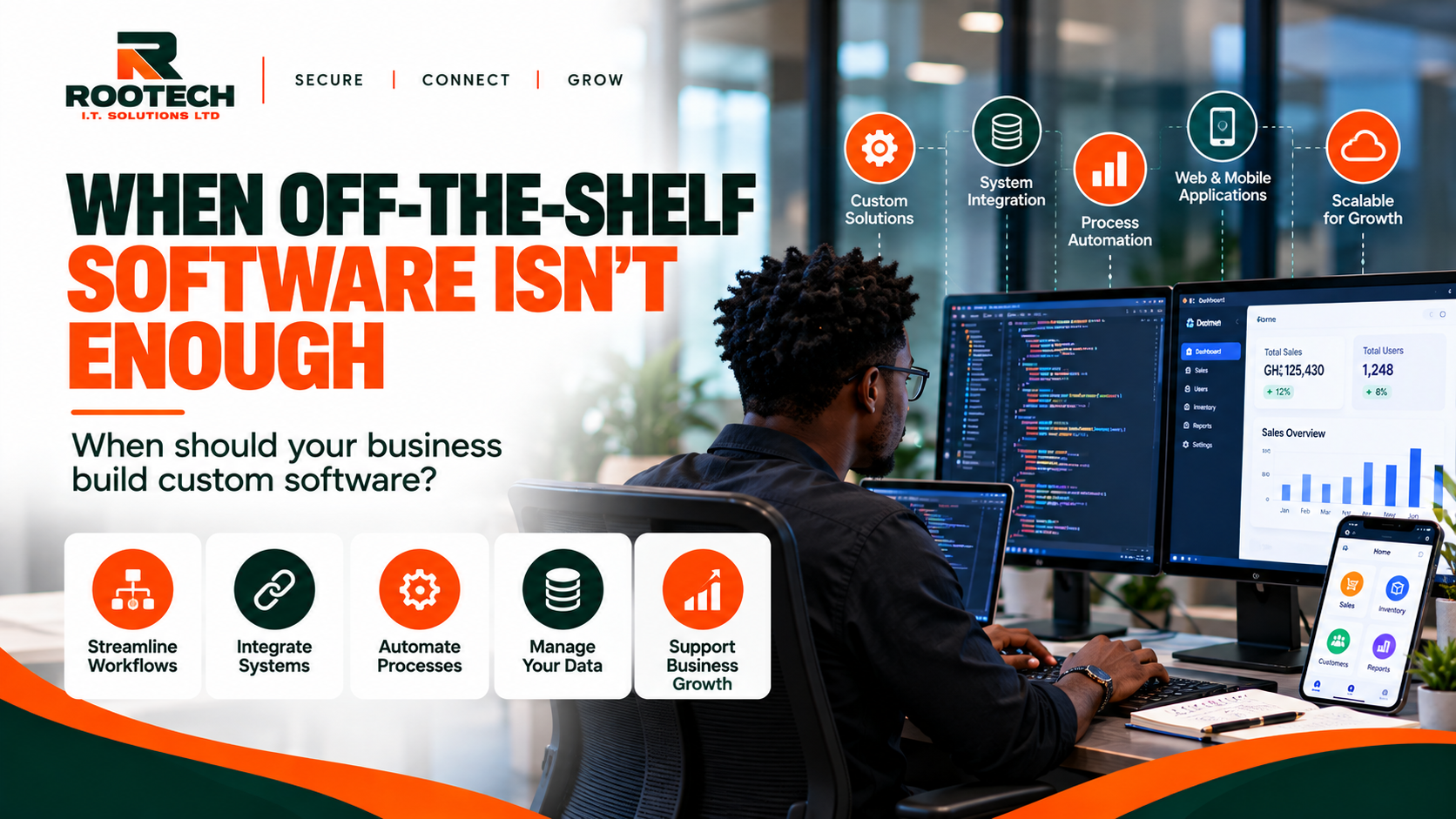
When Off-the-Shelf Software Isn’t Enough: When Should a Business Build Custom Software?
Not every business needs custom software. For many organizations, ready-made software can provide everything they need to manage everyday operations. But as a business grows, its processes can become more specialized, and the software that once worked may no longer fit.
This is where custom software development can become valuable. Custom software is built around a business's specific workflows, requirements and objectives rather than asking the business to adapt completely to an existing product.
Rootech IT Solutions develops custom web and mobile applications, database architectures, offline synchronization systems and localized API integrations for business workflows. (Rootech IT Solutions)
What Is Custom Software?
Custom software is technology developed specifically for an organization or a particular business requirement. Instead of choosing a ready-made system and changing your processes to fit it, the development process begins by understanding how your business operates.
This could involve building:
-
Internal business applications
-
Customer portals
-
Web applications
-
Mobile applications
-
Inventory or management systems
-
Automated reporting platforms
-
Payment integrations
-
Business dashboards
-
Systems that connect multiple existing platforms
The goal is not simply to create something different. The goal is to solve a specific business problem effectively.
1. Your Business Has Workflows That Standard Software Doesn't Support
One of the clearest signs that custom software may be worth considering is when your business has processes that don't fit neatly into existing software. You may find yourself creating spreadsheets, using multiple applications or developing manual workarounds just to complete one process.
For example, a business might need to:
Collect information → process it → generate a report → send it to another system.
If employees have to move information manually between several platforms every day, there may be an opportunity to automate the workflow. Custom software can be designed around that specific process.
2. You're Using Too Many Disconnected Systems
Businesses often accumulate software over time. One system handles customers. Another handles accounting. Another manages inventory. Another collects payments. Then employees use spreadsheets to connect everything together.
This can create duplicated work and make it harder to maintain consistent information. Custom development can help create integrations between systems or provide a central platform for specific business operations.
Rootech's software development services include REST APIs, GraphQL, real-time communication technologies and localized payment integrations. (Rootech IT Solutions)
3. Your Business Needs to Automate Repetitive Work
If your employees repeatedly perform the same manual task, it may be worth asking whether technology can handle part of the process.
Examples include:
-
Generating recurring reports
-
Sending notifications
-
Processing customer requests
-
Collecting information
-
Updating records
-
Managing approvals
-
Synchronizing data
-
Creating invoices or statements
Automation doesn't necessarily mean replacing people. In many cases, it means allowing employees to spend less time on repetitive administrative work and more time on tasks that require human judgment.
4. Your Business Has Unique Data Requirements
Data becomes increasingly important as businesses grow. Some organizations need specialized databases, reporting structures or dashboards that aren't available in standard software. A custom system can be designed around the organization's data requirements, including how information is collected, stored, accessed and presented.
Rootech develops database architectures using technologies including PostgreSQL, MySQL, MS SQL Server and SQLite, depending on project requirements. (Rootech IT Solutions)
5. You're Planning to Scale
Software decisions shouldn't only consider where your business is today. If you're planning to expand into new branches, services, customer segments or markets, your technology needs to be able to support that growth. A custom platform can be designed with future requirements in mind.
For example, a system might initially serve one location but later need to support multiple branches, different user roles, centralized reporting or integrations with other systems.
The important point is to design around the business roadmap, not just today's problems.
Custom Software Doesn't Always Mean Starting From Zero
There is a common misconception that custom software means building an entire technology ecosystem from scratch. That's not necessarily the case. A business may only need a custom application that connects its existing systems.
Another organization may need a new customer portal while keeping its existing accounting software. Another may need an internal dashboard that pulls information from several platforms. The appropriate solution depends on the business problem.
When Should You Consider Off-the-Shelf Software Instead?
Custom software isn't automatically the right choice. If an existing product already provides the features your business needs, purchasing and configuring that product may be more practical.
Before commissioning custom software, businesses should consider:
-
What problem are we trying to solve?
-
Does existing software already solve it?
-
How many employees will use the system?
-
Will the requirements change as the business grows?
-
What systems need to connect?
-
What data needs to be stored?
-
What level of automation is required?
-
What is the long-term cost of maintaining the solution?
A good software project begins with the business problem, not the technology.
Build Technology Around Your Business
The best reason to build custom software isn't simply because you can. It's because your business has a genuine requirement that existing solutions cannot adequately address. When properly planned, custom software can help businesses streamline workflows, connect systems, automate repetitive processes and build digital infrastructure around their specific operations.
At Rootech IT Solutions, software projects begin with an assessment of business workflows before defining the software blueprint and database architecture. (Rootech IT Solutions)
Your business is unique. Your technology can be designed to work that way.
Thinking about a custom software project?
+233 54 631 0011
info@rootechits.com
www.rootechits.com
Japan Motors, Room 6, Adenta, Accra, Ghana (Rootech IT Solutions)
Rootech IT Solutions — Secure. Connect. Grow.
