The Scale Challenge in Modern Infrastructure Delivery
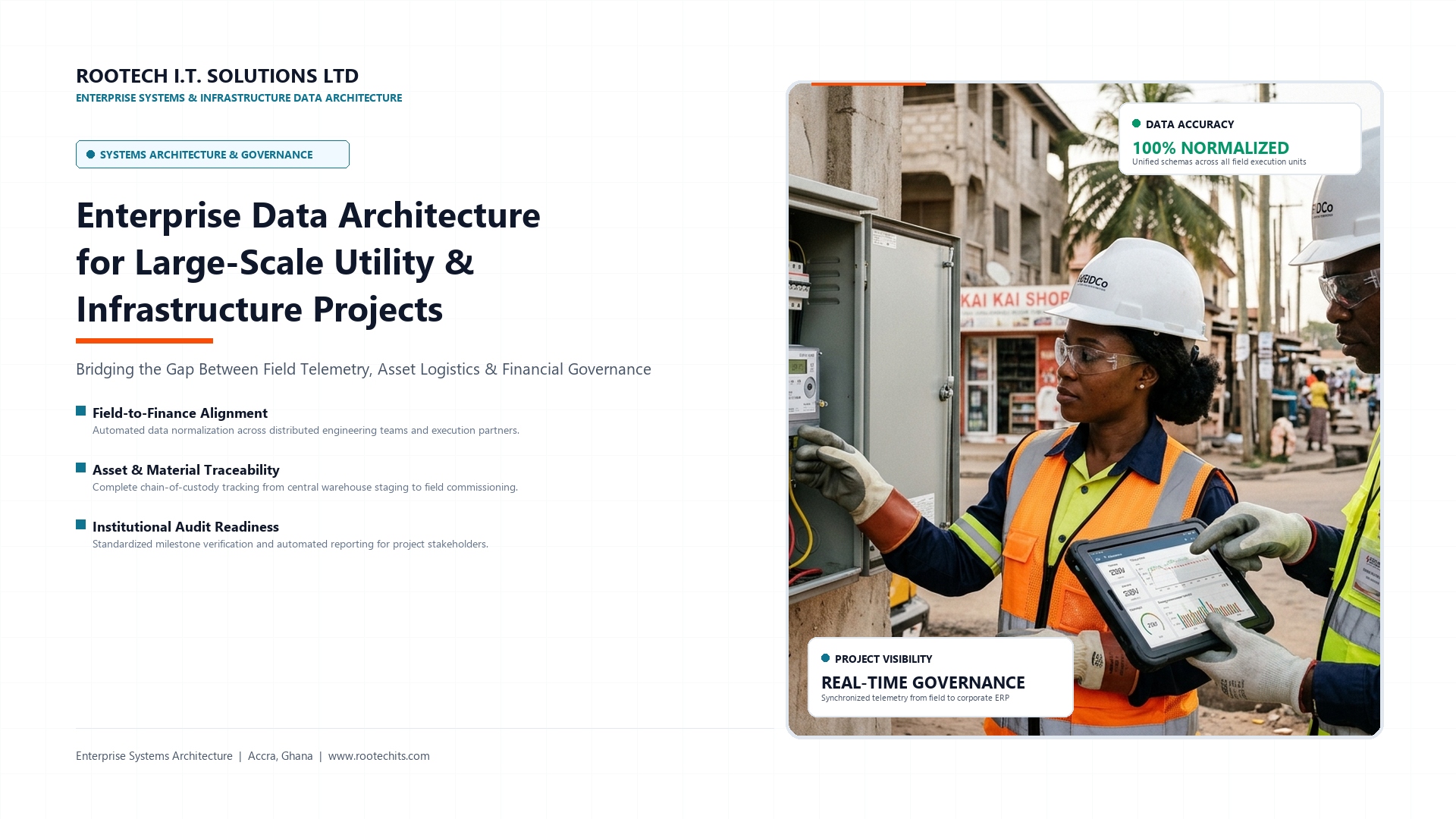
Across emerging markets, large-scale infrastructure projects—from modern smart grid deployments and telecom fiber expansions to municipal water systems and commercial civil works—are accelerating at unprecedented speed.
Engineering and infrastructure organizations deploy hundreds of skilled field technicians, mobilize dozens of regional execution partners, and commission tens of thousands of technical assets across vast geographic areas every month.
On the ground, engineering precision is paramount. Hardware is installed according to strict technical standards, safety protocols are maintained, and field milestones are achieved daily.
Power Your Business with Venta Retail Suite & Enterprise Tech
From offline-ready retail POS billing & cloud ERP to enterprise servers, CCTV surveillance, and managed Wi-Fi, Rootech IT Solutions equips businesses in Ghana for 24/7 reliability.
However, as projects scale into thousands of decentralized physical installations per month, executive leadership and project managers often confront an entirely different operational challenge: The Data Synchronization Gap.
The Operational Disconnect
- Stage 1: Field Operations & Deployments
Field crews record thousands of decentralized installations, serial numbers, and site coordinates daily across different regions. - Stage 2: Supply Chain & Asset Logistics
Central warehouses issue high-value hardware, materials, and components to regional staging depots with independent logging schedules. - Stage 3: Corporate Financial Governance
Finance and project control teams attempt to manually correlate disconnected delivery spreadsheets with milestone invoicing criteria.
When distributed field teams, regional logistics depots, and corporate financial systems operate on disconnected spreadsheets, manual logs, or disparate mobile reporting tools, the lag between physical execution and certified commercial reporting introduces administrative friction.
In modern infrastructure management, operational success is not only determined by physical construction—it is governed by information architecture.
Three Key Data Pillars in High-Volume Infrastructure Delivery
In enterprise infrastructure deployments, organizational performance hinges on the seamless alignment of three distinct operational streams:
1. Field Milestone Normalization
In large engineering programs, multiple specialized teams and execution partners submit daily field logs. These logs capture serial numbers, GPS coordinates, installation timestamps, and customer or site identifiers.
Because different field units often record data in varying formats, central management teams frequently face hours of manual normalization. Without automated data pipelines, subtle formatting variations, incomplete records, or unintended duplicates can create delays in project milestones and progress reporting.
2. Closed-Loop Asset & Material Traceability
High-value technical equipment—such as digital meters, distribution hardware, optical cable runs, specialized enclosures, and security seals—moves continuously from central warehouses to regional staging facilities and ultimately to end-installation points.
Achieving complete, closed-loop traceability requires that every piece of hardware dispatched from inventory is automatically reconciled against certified field commissioning records, returns, and decommissioned assets. Unifying warehouse management systems with field deployment records ensures complete transparency across the entire material lifecycle.
3. Institutional Reporting & Audit Readiness
Major commercial clients, public utilities, and international development financiers require standardized, audit-proof project documentation before certifying milestones and releasing payments.
Meeting these rigorous compliance standards requires programmatic data validation: ensuring that every line item in a commercial submission is backed by verifiable technical attributes, correct regional classifications, and complete traceability.
The Solution: Automated Data Reconciliation Pipelines
To address these operational complexities, forward-thinking infrastructure firms are investing in Enterprise Data Reconciliation Pipelines.
Rather than relying on manual spreadsheet consolidation, an automated data pipeline acts as a central data bridge connecting field operations, warehouse logistics, and corporate ERP systems.
The Rootech 3-Tier Enterprise Data Framework

Tier 1: Distributed Data Capture & Ingestion
- Field Telemetry & Mobile Logs: Structured daily inputs capturing hardware IDs, GPS locations, and installation timestamps.
- Supply Chain Dispatches: Central warehouse releases, regional depot transit, and scrap/return records.
- Execution Partner Submissions: Multi-format logs from third-party contractors and regional sub-teams.
Tier 2: Automated Reconciliation & Processing Engine
- Schema Normalization: Ingests disparate file structures into unified, standardized database tables.
- Integrity & Anomaly Filtering: Programmatically flags duplicate serial numbers, coordinate conflicts, and missing attributes.
- Chain-of-Custody Balance: Reconciles physical stock dispatches against verified field installations and regional stock balance.
- Milestone Rules Engine: Programmatically validates execution deliverables against institutional contract standards.
Tier 3: Unified Executive & Commercial Outputs
- Output A — Executive BI Dashboards: Real-time visibility into project throughput, regional velocity, and material utilization.
- Output B — Institutional Progress Compliance: Audit-ready milestone submissions, transparent partner accounting, and accelerated capital recovery cycles.
Key Operational Benefits for Engineering Leaders
1. Automated Ingestion & Data Hygiene
By defining standardized data schemas across all field reports, the reconciliation engine ingests raw records automatically. The system validates uniqueness constraints (such as unique asset serials), checks geographic consistency, and normalizes field inputs without manual human intervention.
2. Transparent Execution Partner Accounting
For main contractors managing multi-tier delivery models, an automated pipeline provides transparent, objective milestone accounting for every execution partner:
- Automated matching of completed field jobs against authorized work orders.
- Transparent, itemized progress summaries that streamline monthly reconciliations.
- Collaborative clarity that builds long-term trust between main contractors and execution partners.
3. End-to-End Asset Accountability
By linking inventory dispatch logs directly to field installation records, the system establishes a balanced equation across the material lifecycle:
Warehouse Dispatches = Verified Installations + Regional Depot Stock + Decommissioned / Returned Assets
This closed-loop accountability eliminates material blind spots and provides corporate leadership with instantaneous visibility into stock utilization.
4. Accelerating the Working Capital Cycle
When milestone submissions are mathematically validated and formatted to institutional reporting standards from day one, review cycles shrink dramatically. What once took weeks of administrative cross-checking is transformed into a streamlined, automated verification process, significantly accelerating cash flow and capital recovery.
Moving Toward Data-Driven Infrastructure Management
As infrastructure investments expand across Africa, the differentiator between standard contractors and industry leaders is operational maturity.
Investing in robust enterprise data architecture does not require discarding existing workflows. Rather, it introduces a lightweight, intelligent integration layer that elevates data quality, strengthens governance, and protects project margins.
At Rootech I.T. Solutions, we specialize in designing enterprise data systems, operational automation, and custom cloud architectures for high-volume engineering and commercial enterprises.
By transforming complex, fragmented operational data into unified, audit-ready intelligence, we empower infrastructure leaders to scale their operations with confidence, clarity, and control.
Executive Consultation & Systems Architecture
To explore how automated data reconciliation pipelines can enhance your project governance, asset traceability, and milestone reporting, connect with our systems advisory team:
- Company: Rootech I.T. Solutions Ltd
- Office: Room 6, Japan Motors Building, Adenta, Accra, Ghana
- Phone: +233 24 511 9062 / +233 24 511 9062
- Email: info@rootechits.com
- Website: www.rootechits.com
- Solutions Focus: Enterprise Systems Architecture | Data Pipelines & Analytics | Operational Automation